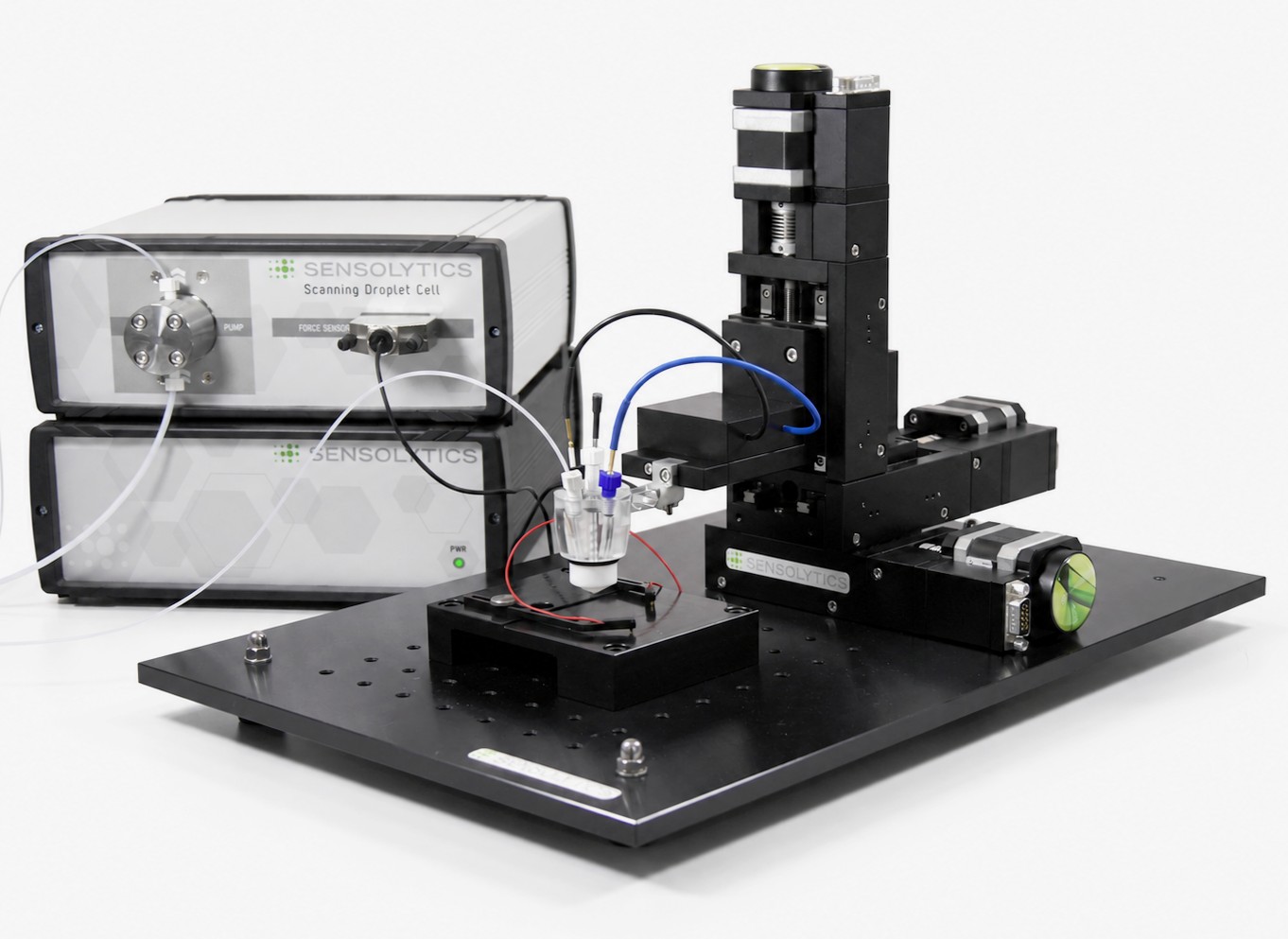
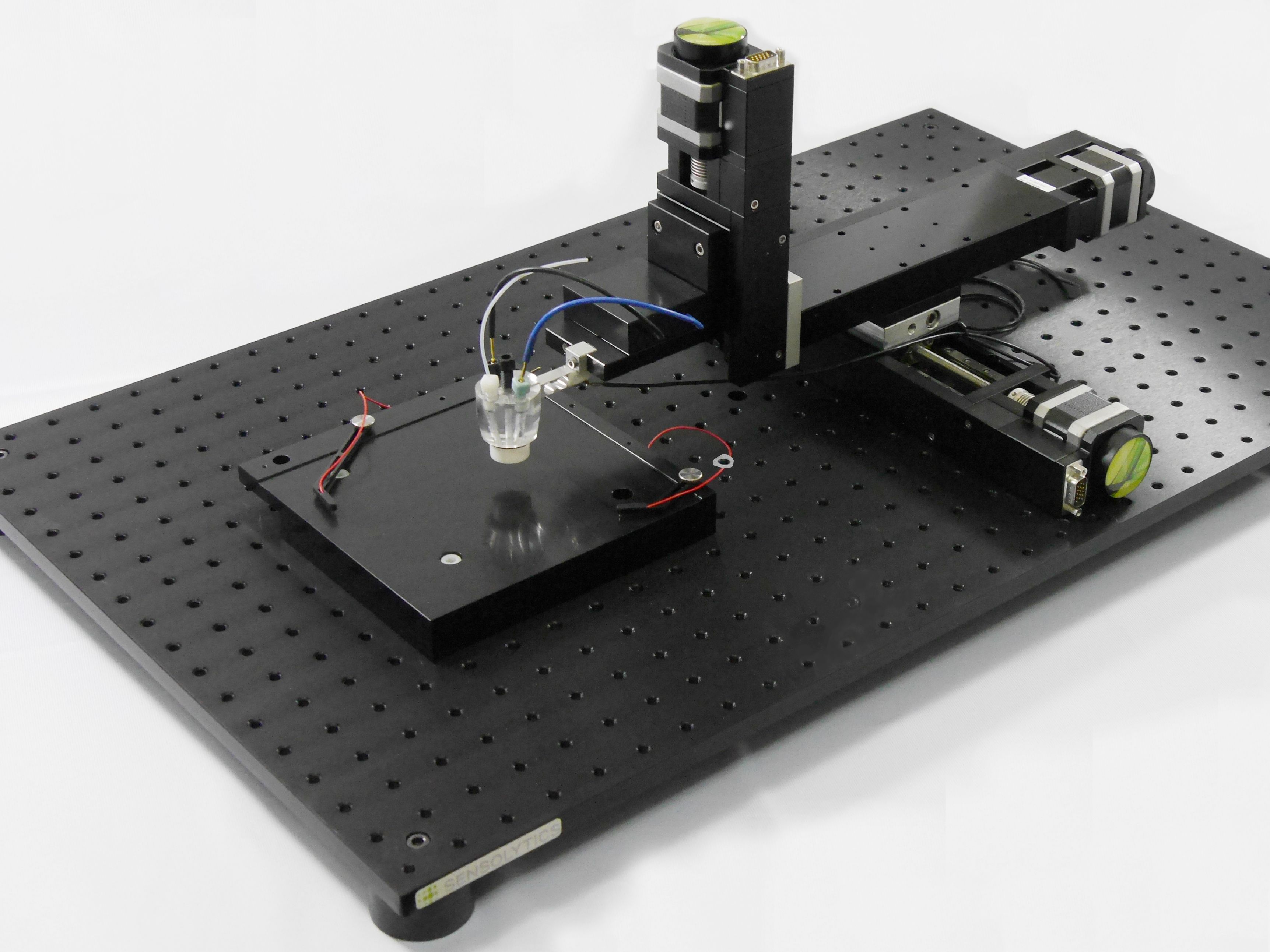
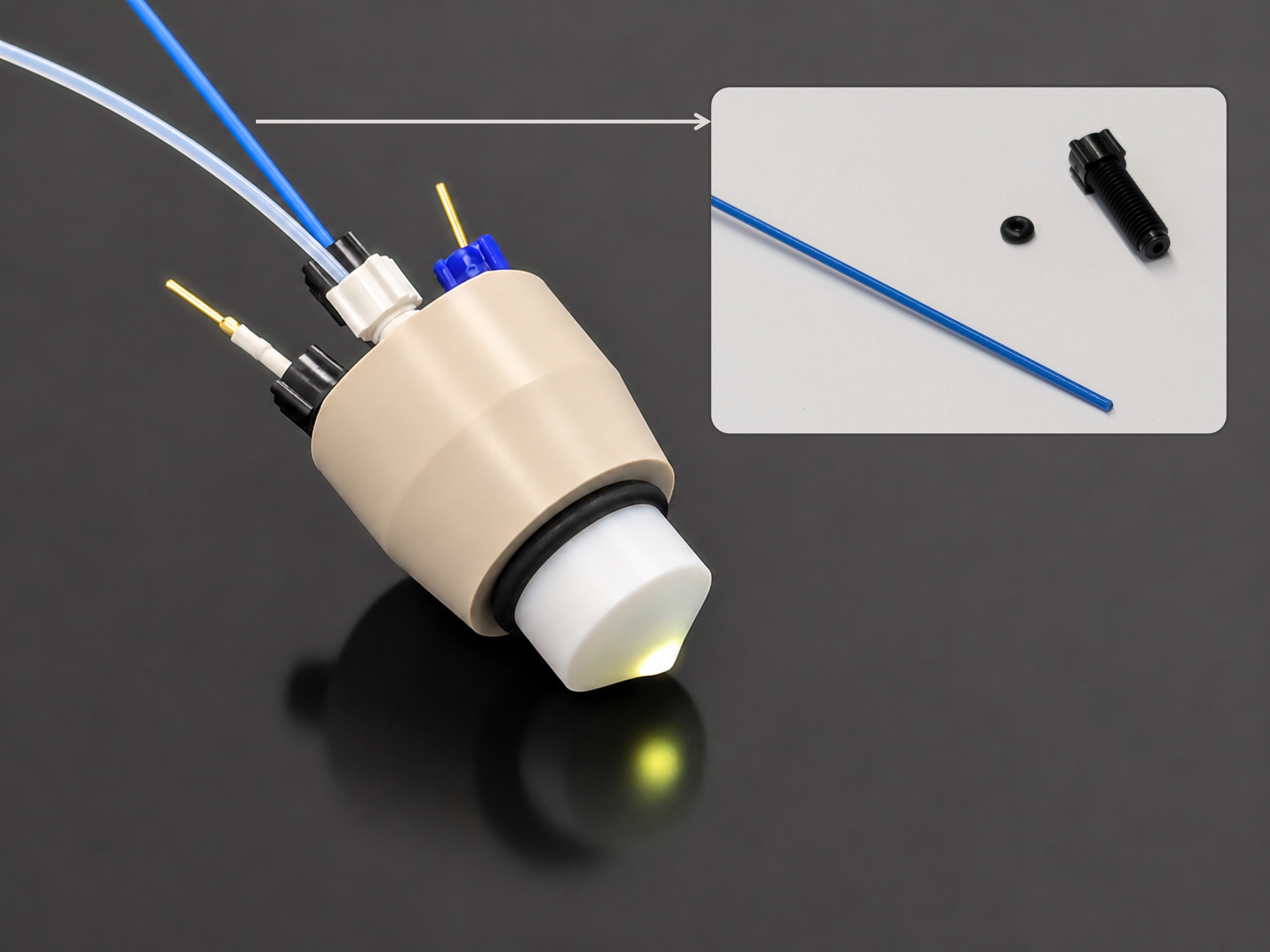
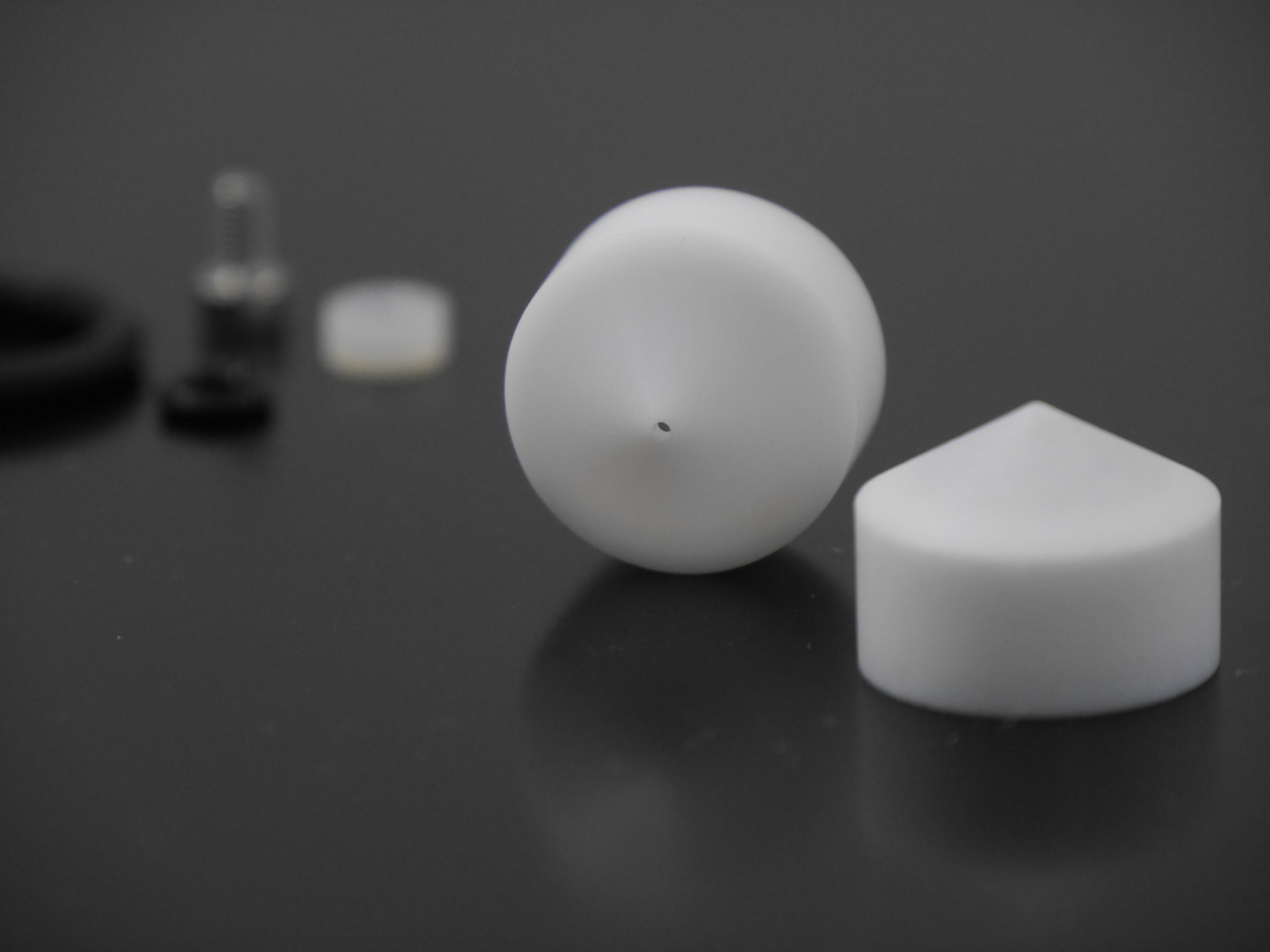
A Scanning Droplet Cell (SDC) is a localized electroanalytical technique that works like a miniaturized mobile electrochemical cell. Therefore, the three-electrode cell assembly is contained within a small reservoir of electrolyte solution that is formed locally on the sample surface, rather than immersing the entire sample surface. In this configuration the sample acts as the working electrode, the electrolyte, reference, and counter electrodes are integrated into the SDC head.
The Sensolytics SDC creates the electrochemical cell by bringing a PTFE tip into controlled mechanical contact with the sample surface. A force sensor applies a defined contact force, creating a reproducible seal between the tip and the sample that confines the electrolyte to a well-defined measurement area.
During a measurement, the confined electrolyte forms a localized three-electrode electrochemical cell allowing for a wide range of electrochemical techniques, such as cyclic voltammetry, electrochemical impedance spectroscopy (EIS), polarization curves, chronoamperometry, and many others, including user-defined routines, at specific, predefined locations on the grid.
After each measurement, the electrolyte is pumped back into the SDC body, the SDC head is lifted off the surface, and moved to the next predefined position. Before the next electrochemical measurement, the probe is automatically rinsed with fresh electrolyte, ensuring that every measurement is performed under identical conditions and preventing cross-contamination between different measurement points.
By repeating this sequence across a user-defined grid, the SDC allows users to generate electrochemical maps with spatial resolution or perform point-specific stationary measurements, enabling a direct comparison of localized electrochemical behavior in heterogeneous materials without affecting the rest of the sample.