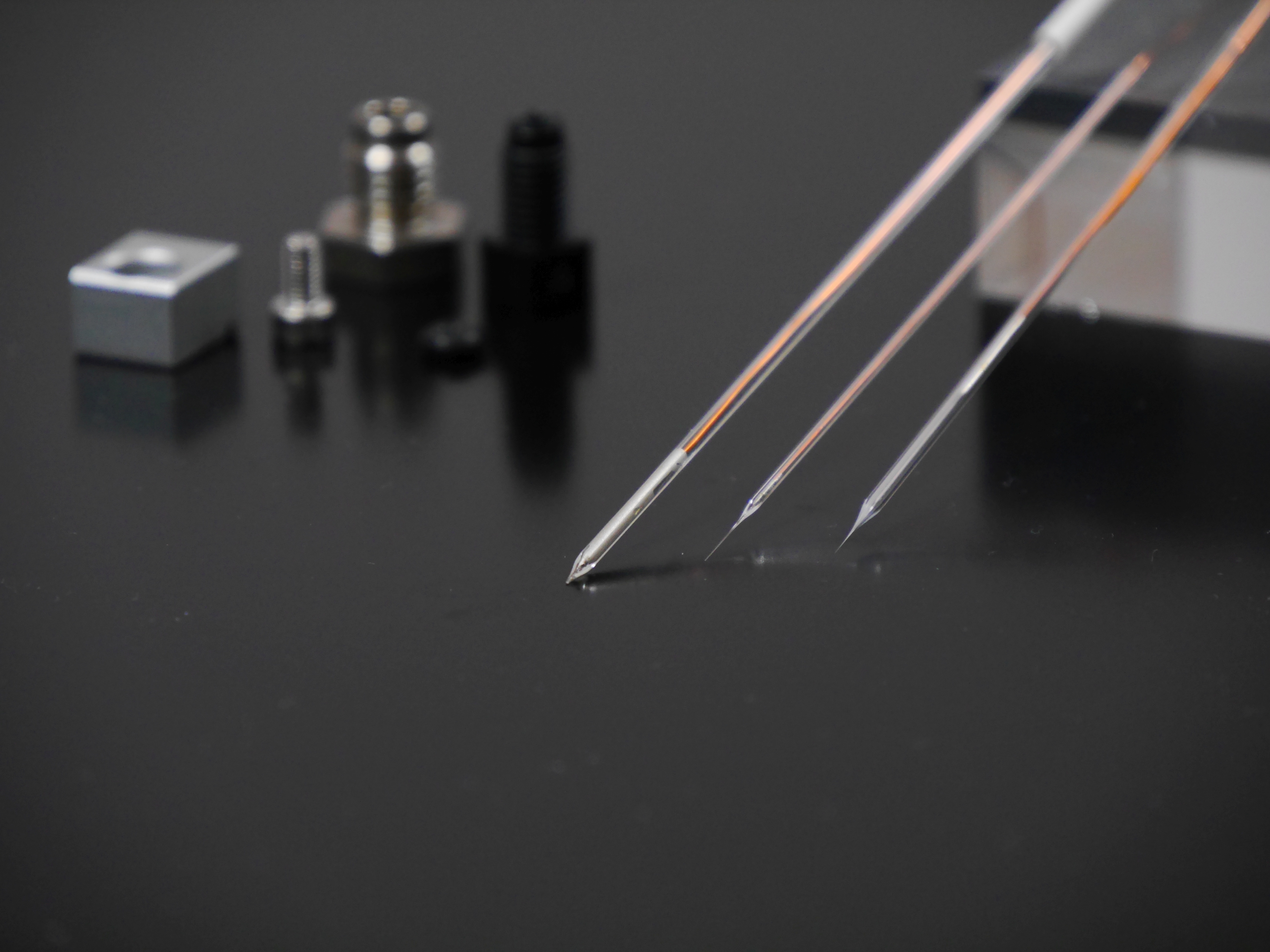
Precision Micro- and Nanoelectrodes for Localized Electrochemistry
Platinum, gold, nickel, and carbon probes, available in a wide range of sizes and geometries, engineered for stable electrochemical measurements, high-resolution images, and multiple SECM modes. With highly customizable designs, Sensolytics SECM probes support reproducible measurements across different applications from corrosion studies to battery research and bioelectrochemistry.
Mechanically robust and easy to polish. Provides high currents (µA-nA range) but limited spatial resolution due to larger diffusion profiles. Suitable for use with the Base SECM System ↗.
Mapping large-area features, patterned surfaces, and high-throughput screening of material libraries where lateral resolution is not critical.
10 - 25 µm diameter
Standard SECM probe size offering a good compromise between robustness, signal level (nA range), and spatial resolution for routine measurements and stable operation. Suitable for use with the Base SECM System ↗.
General-purpose SECM measurements, including kinetic studies, electrocatalysis screening, corrosion analysis, and imaging of biological samples.
1 - 5 µm diameter
High spatial resolution with reduced current levels (pA to low nA). Requires precise positioning and careful approach to avoid tip damage. Recommended use of the Sensolytics Option High-Res ↗.
Localization of electrochemical activity on single cells, detection of enzymatic activity, mapping grain boundaries in metals, and analysis of heterogeneous surfaces and energy materials.
< 1 µm diameter
Nanoscale probes with very high spatial resolution. Extremely fragile and operate at very low currents (pA to fA). Reliable measurements require advanced distance-control techniques. Recommended use of the Sensolytics Option High-Res ↗ and Sensolytics Option Shearforce ↗.
Single-entity electrochemistry (e.g., nanoparticles), nanopore studies, subcellular/intracellular measurements, and investigation of nanoscale features such as solid–electrolyte interphases (SEI) in batteries.
Micro-twin-electrodes (2x25 µm or 2x10 µm diameter)
Dual microelectrode configuration enabling simultaneous detection or generator–collector measurements. Requires a bipotentiostat to polarize both microelectrodes.
Biasing each platinum disk at a different potential to map two distinct redox species concurrently or using one tip as the "generator" (creating a reactant) and the other as the "collector".